
Every invoice transmitted to GSTN carries sensitive commercial information, including pricing structures, transaction values, customer details, and product classifications. When this data moves through multiple systems before reaching GSTN, the question is no longer limited to connectivity. It also involves how securely that data travels across the integration layer.
This is where integration architecture plays a critical role. Among the different models used in GST connectivity today, pass-through API architecture is widely considered the most secure approach for protecting enterprise tax data.
Why Data Privacy Matters in GST Integrations
India’s GST Network now processes billions of e-invoices every year across registered businesses. For large enterprises operating across multiple GST registrations, this translates into thousands of API transactions every month moving between ERP systems and GSTN.
Protecting this information is important because GST data reflects critical commercial relationships and operational patterns. If this information becomes exposed or improperly handled, it can reveal how a company prices its products, manages supplier relationships, and structures transactions across markets.
In 2021, a data incident at a third-party GST filing platform briefly exposed invoice data for thousands of businesses before the issue was contained. No large-scale breach resulted, but it demonstrated that intermediary storage of GST data creates attack surface that pass-through architecture eliminates entirely (1).
Data privacy becomes important in GST integrations for several reasons:
- Commercial confidentiality – Invoices reveal pricing structures, customer relationships, and product classifications.
- Operational visibility – Transaction records indicate sales volumes, purchasing behavior, and supplier networks.
- Financial data protection – GST filings contain tax liabilities and transactional values that must remain secure.
- Enterprise governance – Organizations are responsible for ensuring sensitive financial data is protected across digital systems.
For businesses processing large volumes of GST transactions, protecting this data is a fundamental requirement of modern compliance operations.
(Also Read: How to Fix Common E-Invoice Validation Errors)
What Is Pass-Through API Architecture
A pass through API architecture is a setup where the intermediary works simply as a secure bridge between a company’s system and the GSTN. When the business application sends an API request, the data in encrypted format, the intermediary receives it, securely forwards it to GSTN, and then sends the encrypted response back to the business system. Only business system can decrypt the data of the API.
In this approach, the intermediary’s role is limited to security and connectivity; it handles authentication and smooth routing of requests. It does not store or keep copies of invoices, return files, or any transaction data generated by the company. All business data remains within the enterprise’s own systems.
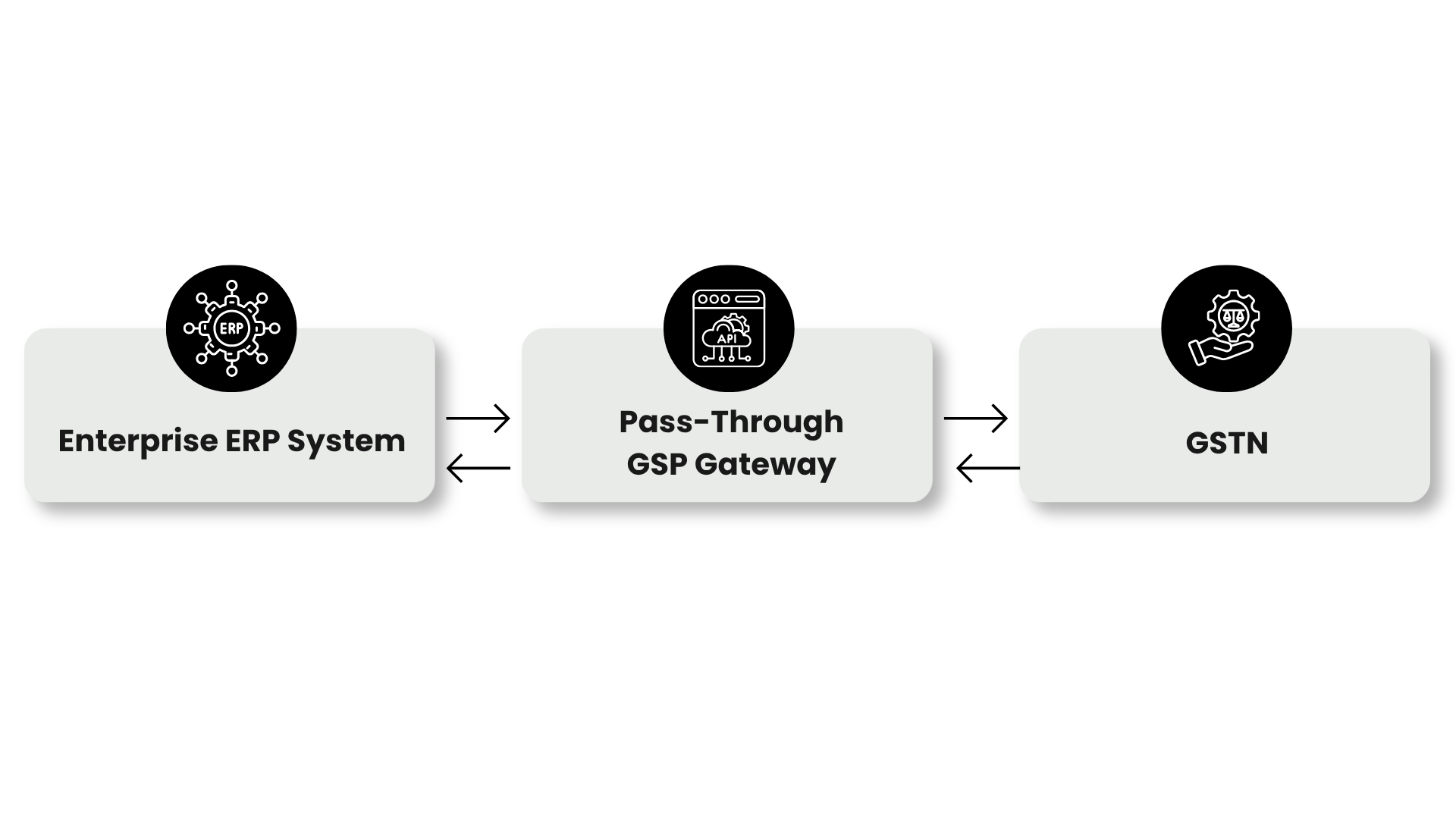
This approach ensures that GST transaction data moves directly between the enterprise system and GSTN during the API call, without creating additional storage layers within intermediary platforms.
In most pass-through implementations, API communication is protected through encrypted transport protocols such as TLS, while authentication tokens issued by GSTN control access to the APIs. The gateway manages authentication and routing without storing the invoice payload, allowing the request and response to move securely between the enterprise system and GSTN.
| Aspect | Traditional API Architecture | Pass-Through API Architecture |
|---|---|---|
| Data Handling | Transaction data may be processed within the intermediary platform | Data is transmitted directly between enterprise systems and GSTN |
| Data Storage | Invoice payloads or return data may be temporarily stored during processing | No storage of transaction data within the gateway |
| Role of Intermediary | Acts as a processing layer between the enterprise system and GSTN | Functions only as a secure communication gateway |
| Data Exposure | Multiple systems may handle sensitive GST information | Data moves through a minimal transmission path |
| Enterprise Data Control | Partial control due to external processing layers | Full control remains with the enterprise system |
Why Pass-Through Architecture Improves Data Privacy
When you use a pass-through architecture, fewer systems get access to GST transaction data during API communication. The intermediary acts only as a gateway, so the data moves straight from the enterprise system to GSTN and then back again as part of the normal request and response flow.
Because the intermediary does not store or read anything, there are no extra databases or storage layers where invoice details or return data can sit. This means sensitive financial information stays only with the systems that create the data and receive the response, reducing unnecessary exposure and keeping control where it belongs.
Pass-through architecture improves data privacy in several ways:
- Minimal data exposure – Transaction data moves through a direct communication path without intermediary storage.
- Reduced external data footprint—Sensitive GST information is not maintained within third-party platform databases.
- Stronger enterprise control – Financial data remains within enterprise systems and GSTN infrastructure.
- Simplified data governance – Fewer systems handling sensitive information makes it easier to manage access and security controls.
Because the intermediary layer does not maintain transaction repositories, enterprises retain complete control over where their GST data resides and how it is governed.
Why Enterprises Prefer Pass-Through Architecture
Enterprises increasingly adopt pass-through architecture because it enables secure, scalable, and highly automated GST compliance without disrupting existing systems or exposing sensitive financial data.
Supports high volume automated GST operations
Large organizations handle thousands or even millions of invoices every month. With API based pass through connectivity, their systems can automatically send invoices, pull return data, and communicate with GSTN directly, without depending on manual uploads through the GST portal.
Maintains control over sensitive financial data
Enterprises see transaction data as a critical business asset. A pass-through architecture makes sure that invoice details and return information stay within the enterprise’s own systems, while the gateway only forwards the request to GSTN and brings back the response.
Improves operational efficiency for compliance teams
When GST communication happens automatically through APIs, compliance teams spend far less time on manual filing work. This allows finance teams to focus more on reconciliation, handling exceptions, and overall compliance oversight.
Handles scale without creating processing bottlenecks
Organizations with multiple GST registrations generate a remarkably high number of API calls for invoice uploads, return filing, and data retrieval. Since the pass-through gateway is focused only on secure communication, it can support this scale without slowing things down or becoming a bottleneck.
Aligns well with enterprise integration strategies
Most large organizations already connect GST processes directly with their ERP and financial systems. A pass-through architecture fits naturally into this setup because it acts as a communication layer rather than adding another processing platform into the mix.
How Excellon Exact Supports Secure GST Connectivity
Excellon EXACT is a pass-through API-based GSP solution, certified by SAP, designed to support secure and high-volume GST integrations for enterprise systems. The platform connects ERP environments such as SAP ECC, SAP S/4HANA, and other ERP systems like Oracle, Dynamics, etc. directly with GSTN through encrypted API communication.
Built on a pass-through architecture, EXACT does not store and read taxpayer transaction data. It functions purely as a secure gateway that transmits GST requests and responses between enterprise systems and GSTN.
The solution supports e-invoicing, e-way bill generation, API-based GST return filing, high-volume transaction processing, and reliable GST connectivity with 99.9% delivered uptime, helping organizations automate compliance while keeping sensitive financial data within their own systems.
Conclusion
As GST compliance becomes increasingly API-driven, the architecture used for GST connectivity plays a key role in protecting sensitive financial data. Pass-through API architecture enables secure communication with GSTN while keeping transaction data within enterprise systems. Platforms like Excellon Exact support this approach by providing reliable GST connectivity built for enterprise-scale operations.