
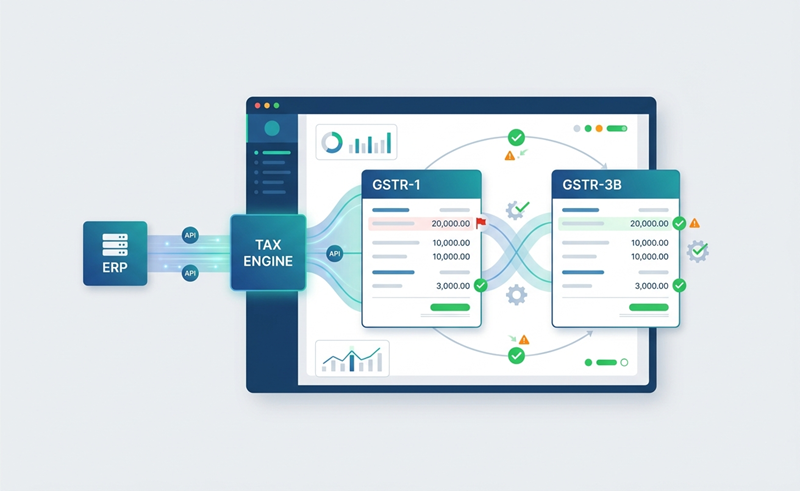
By the time tax teams review the numbers in GSTR-1 and GSTR-3B, the transaction data has already passed through multiple enterprise systems. An invoice is created in the ERP, passes through tax engines and integration layers, and then flows into reporting systems where GST returns are prepared.
When transaction volumes are low, this workflow often goes unnoticed. In contrast, organizations processing thousands of invoices every single day start seeing discrepancies as transaction data moves across systems and returns are compared
That is usually the point where the numbers in GSTR-1 and GSTR-3B begin to diverge. As validations in the GST Network have become stricter over time, these differences are now detected much more quickly than before.
Across industries, a familiar pattern of reconciliation errors tends to surface whenever these two returns are reviewed closely.
Top 7 GSTR-1 and GSTR-3B Reconciliation Errors
Timing Differences Between Invoice Reporting and Tax Liability
One of the most common errors occurs when invoices are reported in GSTR-1 during a particular tax period, but the corresponding liability appears in GSTR-3B in a different period. Most probably this happens when invoices are uploaded, adjustments are done, or corrections are processed after the reporting is cut-off. At high transaction volumes, even a small delay in data consolidation can shift figures from one month to another. When these returns are compared later, differences can appear larger than they are.
Amendments to Previously Reported Invoices
Invoice amendments are routine in many industries. Pricing revisions, credit adjustments, and corrections to customer details happen throughout the year. It becomes difficult when the amendments update the invoice table in GSTR-1, while the tax adjustments are made differently in GSTR-3B. But without tracking it carefully, the changes accumulate and creates a reconciliation gap.
Credit Notes and Debit Notes Not Reflected Consistently
Credit notes and debit notes usually follow their own reporting workflows inside the enterprise systems. Some organizations capture them directly through finance modules, while others process them through separate billing or distribution platforms.
GSTR-1 shows all the sales invoices and the tax that should be collected. GSTR-3B shows the final tax liability that the company reports and pays. Sometimes, an invoice is correctly recorded in GSTR-1, but it does not fully reflect in GSTR-3B due to system or processing gaps.
Tax Rate Classification Errors
Another issue occurs when invoices are tagged with incorrect tax rates or supply classifications during transaction entry. Once the invoice is recorded, that classification flows through the reporting pipeline and it eventually appears in GSTR-1. However, if liability calculations in GSTR-3B follow a different rule set or correction logic, these two numbers do not align with each other. Eventually this problem becomes more visible in organizations who are dealing with multiple product categories and changing GST rate structures.
Manual Adjustments During Return Preparation
Many enterprises still perform last-minute adjustments while preparing summary returns. The finance teams may manually adjust tax liabilities in GSTR-3B to account for provisional entries, internal reconciliations, or late-arriving transactions. These adjustments not always flow back into GSTR-1, leaving the two returns out of sync. Over a few months, these manual corrections accumulate and make reconciliation reviews more complicated.
Data Aggregation Differences Across Systems
In large organizations, GST reports are not always generated from a single system. Transaction data may originate from multiple ERPs, billing platforms, or regional accounting systems. When this information is consolidated before filing GSTR-1 and GSTR-3B, inconsistencies in aggregation logic appear. A slight variation in calculating taxable value or tax amounts across systems can create a gap during reconciliation.
Rounding and Minor Value Variations at Scale
At small volumes, rounding differences do not affect the reconciliation. But when enterprises processing thousands of transactions every day often see small decimal variations start adding up over the time. This usually happens because tax calculations are done in different systems before the final data reaches GSTR-1 and GSTR-3B. Each system may round off values slightly differently. Individually, these differences are too small to notice. But across thousands of invoices, they start adding up and show up as small gaps that teams then must review and adjust.
(Also Read: How to Fix Common E-Invoice Validation Errors)
How to Automate GSTR-1 vs GSTR-3B Reconciliation Using APIs
Automating reconciliation between GSTR-1 and GSTR-3B usually begins with integrating GST compliance processes directly with enterprise systems.
Instead of extracting information manually, organizations integrate their ERP environments with GST compliance platforms through API connectivity with the GST Network. This allows invoice data, tax calculations, and return summaries to move directly between operational systems and the GST reporting infrastructure.
After reconciliation is automated, organisations begin to see improvements in how common filing errors are identified and managed.
Once these integrations are in place, reconciliation can operate continuously within the system itself. Transaction data that feeds GSTR-1 and the tax liability datasets used for GSTR-3B are compared automatically as invoices, amendments, and adjustments move through the reporting workflow.
This shift fundamentally changes how reconciliation is handled.
How Automation Helps Reduce Reconciliation Errors
Instead of identifying gaps at the time of month – end filing, the automated system validates data before generating returns.
The GSTR-1 data is continuously compared with the tax liability calculation that goes into GSTR-3B, and if amendments come in, or a credit note is issued, or even when timing or tax classification changes, the system flags them immediately.
As the transaction volume starts scaling, the visibility arrives early in the cycle, and this allows teams to act in real time, instead of going back later to fix outcomes after they have already been recorded.
This approach ensures that both returns are built on the same validated dataset, and it significantly reduces the reconciliation complexity during the filing cycle.
For organizations processing high transaction volumes, early validation brings down manual reconciliation efforts across the compliance process.
Today, automation is driving a nearly 40% reduction in compliance effort while significantly shortening filing cycles through streamlined reconciliation processes.
Platforms like Excellon Exact – A GSP API Solution support the automated compliance framework.
Exact connects your systems directly with the GST Network, and supports real-time e-invoice processing, GST returns, and reconciliation workflows through API-based integration.
As the transaction data is continuously validated, you get visibility into the discrepancies at an early stage.
For enterprises handling large transaction volumes, instead of waiting for month-end and spending time investigating and fixing issues, reconciliation happens continuously in the background. It becomes a stable, ongoing process that runs along with normal business activities without requiring heavy manual effort.
Contact Us
Understanding India’s GST 2.0 Reforms and Compliance Framework
Latest News