A warehouse team waits for dispatch clearance.
The trucks are loaded. The goods are ready. The finance system shows invoices generated.
Then a notification appears on the dashboard.
IRP rejection
- Invalid GSTIN.
- Duplicate invoice number.
- Schema validation error.
One rejected invoice delays a shipment. Ten rejected invoices slow down the entire dispatch line. When an organization processes thousands of invoices every day, these small interruptions quietly expand into operational bottlenecks.
Many businesses treat such errors as routine compliance hurdles. Yet the real issue sits deeper in the invoicing workflow. Most validation failures occur long before the invoice reaches the government system.
Organizations that correct validation errors in real time maintain smooth billing cycles. Those that detect them late often find their finance teams caught in repeated correction loops.
Understanding where these errors originate and how enterprises prevent them can significantly improve invoicing efficiency.
Understanding How the E-Invoice Validation Process Works
Every e-invoice generated in India must pass validation checks before the Invoice Registration Portal assigns an Invoice Reference Number (IRN).
The Invoice Reference Number (IRN) is generated by the IRP using a hash algorithm based on the supplier GSTIN, invoice number, document type, and financial year. This mechanism ensures that every invoice registered on the system is uniquely identifiable and prevents duplicate submissions across the GST network.
Most companies generate invoices through ERP systems, which then transmit the data to the government network.
The workflow usually follows this path.
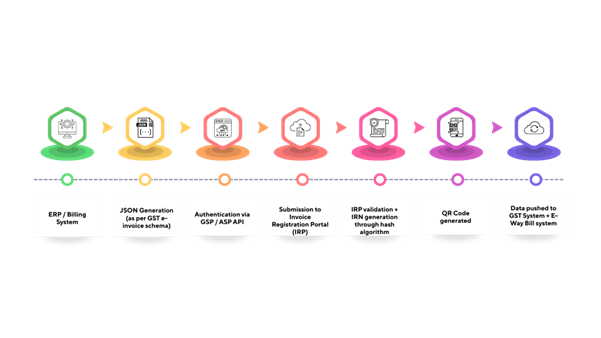
Once the IRN is generated, the invoice data is also transmitted by IRP to the GST system and the e-way bill system, enabling seamless compliance reporting and logistics documentation.
The QR code generated by the IRP contains key invoice parameters such as supplier GSTIN, buyer GSTIN, invoice number, invoice date, invoice value, and IRN. This enables tax authorities and other stakeholders to verify invoice authenticity through GST verification tools.
During validation, the portal checks several parameters:
- Supplier GSTIN
- Document date
- Item details
- Tax rate
- Invoice value
- Buyer GSTIN
- State code
- Supply type
- Item serial number
If any parameter fails validation, the portal rejects the invoice immediately and returns an error response to the ERP system.
The finance team must then correct the data, regenerate the invoice, and submit it again.
In high-volume environments, this correction loop can repeat hundreds of times in a single day.
IRN hash logic
The Invoice Reference Number (IRN) is generated by the IRP using a hash algorithm based on the supplier GSTIN, invoice number, financial year, and document type. This ensures that each invoice is uniquely identifiable across the GST system.
Common E-Invoice Validation Errors
Even mature ERP environments encounter similar validation failures. Most of these issues originate from internal data inconsistencies rather than the government system itself.
When validation fails, the IRP returns structured error codes that help ERP systems identify the exact reason for rejection. These error responses allow finance and IT teams to quickly diagnose issues such as invalid GSTINs, incorrect HSN codes, or schema mismatches before resubmitting the invoice.
Invalid or Inactive GSTIN
Customer GST numbers often remain stored in ERP master records for long periods. A GSTIN may become inactive due to compliance changes or simple data entry errors.
When the invoice reaches the portal with an invalid GSTIN, validation fails instantly.
Duplicate Invoice Numbers
The portal requires every invoice number to remain unique for a given GSTIN within a financial year.
Organizations operating multiple billing systems sometimes generate overlapping invoice sequences. When duplication occurs, the system blocks IRN generation.
The IRP prevents duplicate invoices by generating the IRN using a hash of the supplier GSTIN, document type, invoice number, and financial year. If the same combination is submitted again, the system rejects the request as a duplicate.
Missing Mandatory Fields
The GST e-invoice schema requires specific fields in every invoice. The GST e-invoice schema contains more than one hundred structured fields, out of which several fields are mandatory depending on the nature of the transaction. These include supplier GSTIN, buyer GSTIN, document number, document date, item details, taxable value, tax rate, place of supply, and total invoice value.
Common examples include
HSN code
Place of supply
Taxable value
Supply type
Document category
If the JSON structure lacks any required field, the portal rejects the invoice. The IRP returns structured error codes that allow ERP systems to identify the exact validation failure.
HSN Requirement
HSN requirement depends on turnover threshold. The number of HSN digits required depends on the supplier’s turnover as prescribed under GST notifications.
| Turnover | HSN Digits |
|---|---|
| Up to ₹5 crore | 4 digits |
| Above ₹5 crore | 6 digits |
Tax Calculation Mismatch
Tax inconsistencies often arise when ERP configurations differ across business units.
Examples include:
- incorrect IGST application
- rounding inconsistencies
- mismatch between line-item tax and total tax
The portal validates these numbers carefully. When values do not align, the invoice fails validation.
Incorrect Document Type or Reference
Credit notes and debit notes must reference the original invoice correctly.
Improper document codes or missing references often trigger validation errors during submission.
| Validation Error | Typical Cause | Operational Impact |
|---|---|---|
| Invalid GSTIN | Incorrect master data | IRP rejection |
| Duplicate invoice | Numbering conflict | IRN failure |
| Missing fields | Schema mismatch | Validation error |
| Tax mismatch | Calculation issue | Invoice rejection |
Once an IRN is generated, the invoice cannot be modified on the portal. If a correction is required, the invoice must be cancelled within 24 hours on the Invoice Registration Portal. After this window expires, adjustments must be handled through credit notes or GST return processes.
Why These Errors Persist in Enterprise Systems
Enterprise ERP platforms manage financial transactions effectively. However, most were not originally built to validate regulatory schemas that change periodically.
E-invoicing introduces several new operational layers.
- GST schema rules evolve.
- Regulatory updates appear periodically.
- Organizations run multiple billing systems across locations.
- Invoice volumes increase as businesses grow.
In many environments, validation happens only after the invoice reaches the portal.
This reactive approach creates a cycle where finance teams correct errors after rejection instead of preventing them earlier in the process.
As invoice volumes grow, this model becomes inefficient.
How Enterprises Fix E-Invoice Validation Errors in Real Time
Organizations processing large invoice volumes rarely depend on manual corrections alone. Instead, they introduce validation mechanisms inside their invoicing architecture so that issues are detected before the invoice reaches the portal.
Several operational controls support this approach.
1. Master Data Validation
Reliable invoicing begins with accurate master data.
Organizations regularly verify GSTIN records, state codes, and legal entity details within their ERP systems. Automated verification helps identify inactive or incorrectly formatted GST numbers before invoices are generated.
2. Schema Validation Before Submission
The JSON structure used for e-invoicing must comply with the GST schema specifications.
Validation checks confirm that mandatory fields exist and that field formats follow regulatory requirements before transmission.
This step eliminates many schema-related rejections.
In modern implementations, validation often occurs through API-driven connectivity layers linking ERP systems with GST infrastructure, allowing invoice data to be verified in real time.
3. Automated Tax Logic Verification
Tax calculations must remain consistent across line items and invoice totals.
Organizations implement validation rules inside their billing systems to ensure the correct tax structure applies based on supply location and transaction type.
Early verification prevents mismatches during portal validation.
4. Invoice Sequence Governance
Organizations operating multiple billing locations often establish centralized invoice numbering policies.
Clear governance prevents duplication conflicts and ensures every invoice reference remains unique within the financial year.
5. Real-Time Monitoring and Scalable Processing
Real-Time Error Monitoring API-based integrations allow systems to receive validation responses instantly. Finance teams can identify issues quickly and resolve them without slowing the entire billing cycle.
The Role of a GSP API in Real-Time Validation
Connecting enterprise systems directly with the GST network involves several technical requirements.
Authentication protocols, encryption standards, and regulatory schema changes must all be managed consistently.
A GST Suvidha Provider API acts as the structured bridge between enterprise systems and the government network.
This layer manages:
- secure API connectivity
- JSON data transmission
- authentication sessions
- high-volume request handling
Organizations using API-driven connectivity often process invoices faster while maintaining better control over validation workflows.
How Excellon Exact GSP API Supports Real-Time E-Invoicing
Many enterprises prefer to retain their existing ERP environments while ensuring reliable GST connectivity. Excellon Exact operates as an API-driven GST Suvidha Provider infrastructure designed to connect enterprise systems directly with GSTN platforms. Instead of replacing existing billing systems, the platform functions as a secure pass-through layer that allows invoice data to move smoothly between enterprise applications and the Invoice Registration Portal.
Key capabilities include:
- direct API connectivity with GSTN
- secure JSON transmission
- scalable processing for high transaction volumes
- seamless ERP integration
- real-time response handling
Organizations using API-based connectivity can process invoice validations efficiently while maintaining alignment with GST compliance requirements.
Why Organizations Choose Exact GSP API
As invoice volumes grow, organizations require infrastructure that keeps compliance operations stable even during peak transaction loads.
Exact GSP API addresses these requirements through several enterprise-grade capabilities.
- Enterprise-Ready SAP Certified GSP API
- Unified Compliance Platform
- Large Data Volume Processing
- Continuous Regulatory Alignment
- Cloud Infrastructure for Reliable Processing
- Scalable for Business Growth
- Secure Data Handling
- 99.9% Uptime
- Dedicated Support
Best Practices to Prevent E-Invoice Validation Errors
Organizations that maintain stable invoicing workflows usually follow disciplined operational practices.
These include:
- maintaining accurate GST master data
- implementing structured invoice numbering policies
- validating invoice schema before submission
- automating tax calculation checks
- monitoring portal response codes regularly
- integrating ERP systems with GST infrastructure through APIs
- Consistent governance around these areas significantly reduces validation failures.
Final Thoughts
E-invoice(1) validation errors often appear small when viewed individually. At scale, however, they influence dispatch timelines, finance workflows, and billing efficiency across the organization.
Once the IRN is generated and the invoice is registered with the IRP, the invoice details cannot be modified. Any required correction must be performed by cancelling the original IRN within the permitted window and issuing a fresh invoice.
Companies that rely heavily on manual correction cycles eventually face operational friction as invoice volumes increase.
Organizations that implement real-time validation mechanisms maintain predictable invoicing operations while keeping compliance aligned with regulatory requirements.
Many enterprises implement pre-submission validation checks within their ERP systems. These checks typically verify GSTIN structure, HSN codes, tax rate consistency, state code mapping, invoice numbering rules, and mandatory schema fields before the invoice is transmitted to the IRP.
Reliable connectivity infrastructure, disciplined data governance, and structured validation processes together create a stable foundation for high-volume e-invoicing.