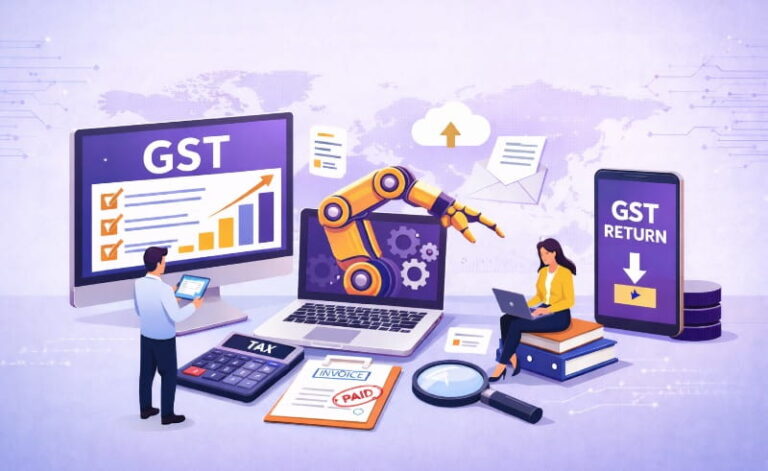
Every month, Indian enterprises process thousands or sometimes millions of invoices, credit notes, and adjustments across ERP, billing, and finance systems. The difficulty is rarely understanding GST rules. The real challenge lies in maintaining consistent, reliable data movement across systems while meeting statutory timelines without operational disruption.
When compliance depends on spreadsheets or manual portal interactions, discrepancies remain hidden until the filing window. Even small mismatches can delay working capital recovery, trigger audit scrutiny, or increase external consultant dependency.
As transaction volumes increase and e-invoicing becomes standard, compliance accuracy directly influences financial reporting confidence and internal control maturity. In e-invoicing environments, automation also manages IRN generation via IRP APIs, validates signed invoice JSON payloads, captures QR code data, and ensures alignment between IRN data and downstream GSTR-1 reporting. Leadership teams are recognizing that GST filing is no longer a monthly tax activity. It is a continuous data governance process embedded within enterprise systems.
GST automation addresses the problem at its source by enabling direct, structured system-to-GSTN integration through certified APIs. Compliance shifts from reactive correction to predictable operational control.
What GST Automation Means in Practice
GST automation does not replace ERP or accounting systems. It connects them directly to GSTN through certified API frameworks that maintain data integrity across the filing lifecycle.
Traditional approaches rely on spreadsheets or semi-automated tools that operate outside enterprise systems. Automation embeds validation, traceability, and structured rule enforcement directly within transaction flows. Every invoice, amendment, and credit note is validated in real time before entering GSTR-1 or influencing GSTR-3B.
As operational complexity increases through multi-state operations, cross-entity billing, or seasonal volume spikes, automated workflows maintain alignment without increasing manual effort. Compliance becomes consistent rather than deadline driven.
(Also Read: How to Choose the Best GSP for the GST Compliance)
Automation vs Traditional Compliance Tools
Many organizations use portal filing utilities or reconciliation tools that still require manual data preparation.
True automation involves:
- Secure token-based GSTN API connectivity with managed authentication lifecycle handling JSON schema-level and business rule validation aligned with GSTN return formats. Rule-driven reconciliation across GSTR-1, GSTR-3B, and GSTR-2B datasets
- Immutable audit logging and end-to-end traceability from source transaction through API submission and GSTN acknowledgment
This distinction becomes critical for enterprises managing large volumes or operating across multiple business units.
The GST Compliance Burden for Indian Enterprises
Organizations that file on time still face hidden operational friction. Data fragments across ERP modules, billing platforms, and finance applications. Minor classification differences or timing gaps may appear insignificant at the transaction level but lead to large scale mismatches when aggregated into returns.
The operational burden appears in several ways:
- Repeated verification cycles before filing that consume senior finance bandwidth
- Month end stress due to late discovery of amendments or credit notes
- High reliance on individual team expertise rather than system assurance
- Complex audit responses requiring reconstruction of transaction logic
- Working capital delays caused by ITC mismatches or rejected filings
FICCI Industry Survey reports that nearly 87% of Indian taxpayers encounter GST reconciliation or filing challenges.
As enterprises expand through acquisitions, regional growth, or new product lines, the number of data sources increases. Without structured automation, compliance complexity grows faster than transaction volume.
How GST Automation Simplifies Compliance Operations
Automation aligns compliance with everyday operational processes instead of treating filing as a separate activity.
- Continuous validation checks for duplicates, missing fields, or incorrect GSTINs at the point of transaction entry
- Embedded reconciliation engines compare outward liability (GSTR-1), tax payment summaries (GSTR-3B), and auto-drafted inward supply data (GSTR-2B) using configurable variance thresholds and exception tagging.Structured audit trails ensure every return is traceable from ERP source to GSTN submission
- Version control tracks amendments across filing cycles
Managing Complex GST Scenarios Through Structured Automation
Enterprise GST operations involve more than standard transactions. Automation introduces consistency and governance across complex use cases:
- Reverse Charge Mechanism (RCM) transactions identified through vendor master tagging and automated liability computation logic
- Inter-state and intra-state supplies validated through place-of-supply logic and GSTIN state code verification
- Amendments tracked across filing periods with full version history
- ITC reversals and credit mismatches identified before return submission
- Export and import transactions aligned with customs or ERP data sources
Standardized rule enforcement ensures that GST interpretation remains consistent across regions and business units. This reduces dependency on local judgment and strengthens internal control frameworks.
(Also Read: E-Invoicing Software in India: A Complete Guide for Businesses)
Business Outcomes Enabled by GST Automation
Organizations that implement structured GST automation report measurable operational and financial benefits:
- Sustained alignment between GSTR-1 and GSTR-3B through continuous validation
- Early visibility into filing readiness during monthly close cycles
- Reduced reconciliation effort and lower dependency on external consultants
- Faster audit response with complete traceability across transactions
- Improved internal control maturity and reduced compliance risk exposure
- Scalable compliance capability that grows with transaction volumes and business expansion
GST compliance becomes a governed enterprise process supported by system assurance rather than manual oversight.
Where a GSP API Layer Fits in Enterprise GST
Automation relies on a certified and reliable API integration layer that connects enterprise systems directly with GSTN. This is where a specialized GSP API solution becomes essential.
A structured GSP API layer enables:
- Secure system to GSTN connectivity without manual portal interaction
- Real time validation of transaction data before filing
- Consistent submission architecture across business units and entities
- High volume processing with reliable API performance
- Continuous synchronization between ERP transactions and GST returns
Excellon Exact GSP API Solution provides a certified integration framework that acts as the compliance connectivity backbone for enterprises seeking scalable GST automation. Instead of replacing existing ERP or finance systems, it strengthens the integration layer that governs data flow, validation, and submission accuracy.
This approach supports organizations that already operate mature ERP environments and want a reliable GSTN integration infrastructure without adding operational complexity.
Final Thoughts
GST compliance in India has shifted from periodic filing to continuous financial governance. As transaction volumes grow and regulatory scrutiny increases, organizations require structured automation that ensures data integrity from source systems to GSTN.
Automation supported by a robust GSP API integration layer transforms compliance into a predictable, scalable process. Finance teams gain early visibility, leadership gains confidence in reporting accuracy, and enterprises reduce operational risk associated with high volume tax operations.
Organizations that treat GST automation as part of enterprise control architecture are better positioned to maintain compliance accuracy while supporting growth across regions, products, and business entities.
Contact Us
Understanding India’s GST 2.0 Reforms and Compliance Framework
Latest News